MESOZOIC ERA
(251 - 65 Million Years Ago)
The Mesozoic era is divided into three periods: Triassic, Jurassic and the Cretaceous period. At the beginning of the Mesozoic era the continents were joined together as the massive mother continent we call Pangaea. It was during the Triassic, Jurassic and Cretaceous period that Pangaea was transformed into the modern continents we know know today.
Triassic Period
(251 - 200 Million Years Ago)
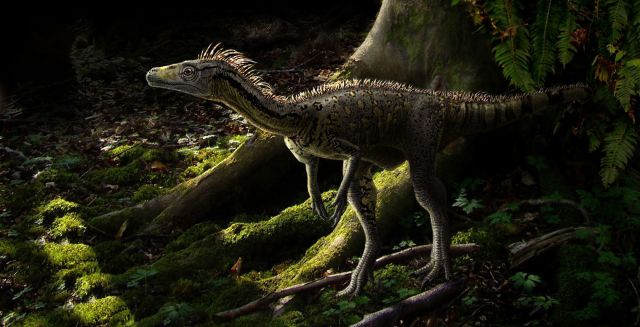
The early Triassic period followed the great mass extinction at the end of the Permian Period and was a time when life outside of the oceans began to diversify. At the beginning of the Triassic, most of the continents were concentrated in the giant C-shaped supercontinent, Pangaea. Climate was generally very dry over much of Pangaea with very hot summers and cold winters in the continental interior. A highly seasonal monsoon climate prevailed nearer to the coastal regions. Although the climate was more moderate farther from the equator, it was generally warmer than today with no polar ice caps. Late in the Triassic, seafloor spreading in the Tethys Sea led to rifting between the northern and southern portions of Pangaea, which began the separation of Pangaea into two continents, Laurasia and Gondwana, which would be completed in the Jurassic Period. However the first dinosaurs did not walk the earth until the late Triassic period starting around 230 million years ago.
Jurassic Period
(200 - 146 Million Years Ago)
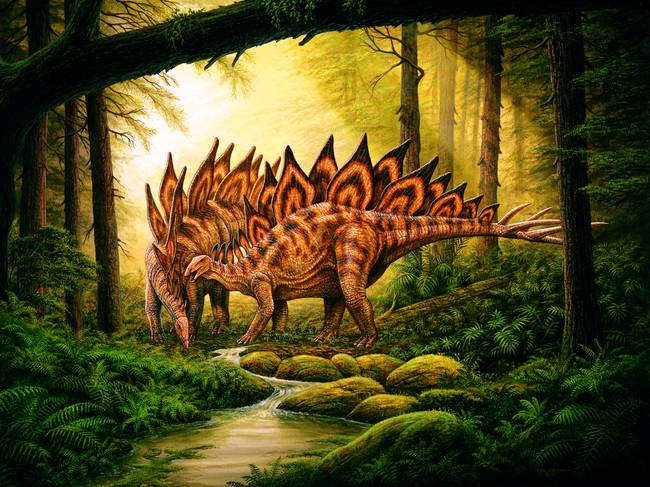
At the start of the Jurassic period, the breakup of the supercontinent Pangaea continued and accelerated. Laurasia, the northern half, broke up into North America and Eurasia. Gondwana, the southern half, began to break up by the mid-Jurassic. The eastern portion—Antarctica, Madagascar, India, and Australia—split from the western half—Africa and South America. New oceans flooded the spaces in between. Mountains rose on the seafloor, pushing sea levels higher and onto the continents. All this water gave the previously hot and dry climate a humid and drippy subtropical feel. Dry deserts slowly took on a greener hue. Palm tree-like cycads were abundant, as were conifers such as araucaria and pines. Ginkgoes carpeted the mid- to high northern latitudes, and podocarps, a type of conifer, were particularly successful south of the Equator. Tree ferns were also present. The oceans, especially the newly formed shallow interior seas, teemed with diverse and abundant life. At the top of the food chain were the long-necked and paddle-finned plesiosaurs, giant marine crocodiles, sharks, and rays. Fishlike ichthyosaurs, squidlike cephalopods, and coil-shelled ammonites were abundant. Coral reefs grew in the warm waters, and sponges, snails, and mollusks flourished. Microscopic, free-floating plankton proliferated and may have turned parts of the ocean red. On land, dinosaurs were making their mark. The plant-eating sauropod Brachiosaurus stood up to 52 feet (16 meters) tall, stretched some 85 feet (26 meters) long, and weighed more than 80 tons. Diplodocus, another sauropod, was 90 feet (27 meters) long. These dinosaurs' sheer size may have deterred attack from Allosaurus, a bulky, meat-eating dinosaur that walked on two powerful legs. But Allosaurus and other fleet-footed carnivores, such as the coelurosaurs, must have had occasional success. Other prey included the heavily armored stegosaurs. The earliest known bird, Archaeopteryx, took to the skies in the late Jurassic, most likely evolved from an early coelurosaurian dinosaur. Archaeopteryx had to compete for airspace with pterosaurs, flying reptiles that had been buzzing the skies since the late Triassic.
Cretaceous Period
(146 - 65 Million Years Ago)
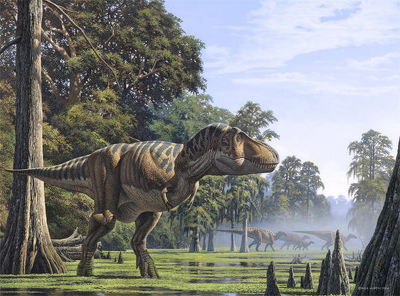
Continents were on the move in the Cretaceous, busy remodeling the shape and tone of life on Earth. At the start of the period, dinosaurs ruled the loosening remnants of the supercontinent Pangaea as rodents scurried at their feet through forests of ferns, cycads, and conifers. At the end of the period, about 80 million years later, oceans filled yawning gaps between isolated continents shaped much as they are today. Flowering plants were spreading across the landscape. And mammals sat poised to fill the void that soon would be left by the vanished dinosaurs. A giant crater smoldered on what would become known as the Yucatán Peninsula. Whether or not the asteroid or comet that carved the Chicxulub crater caused the extinction of more than half the planet's species at the end of the Cretaceous remains a matter of scientific debate. But the shifted continents, expanded coasts, and widened oceans had cooled and moistened the planet's climate and set in motion dramatic changes to the flora and fauna. An extraterrestrial impact or a bout of volcanism from within was perhaps too much for many of Earth's species to handle. Long before the carnage began, the Cretaceous picked up where the Jurassic left off: Gigantic sauropods led parades of dinosaurs through the forests, over the plains, and along the coasts; long-necked and toothy marine reptiles terrorized fish, ammonites, and mollusks in the seas; pterosaurs and hairy-feathered birds filled the skies. But as the continents spread, the ocean currents churned with ever more vigor. After a temperature spike in the mid-Cretaceous, the climate began to cool, and the tenor changed. Though dinosaurs ruled throughout the Cretaceous, the dominant groups shifted and many new types evolved. Sauropods dominated the southern continents but became rare in the north. Herd-dwelling ornithischians like Iguanodon spread everywhere but Antarctica. Toward the close of the Cretaceous, vast herds of horned beasts such as Triceratops munched cycads and other low-lying plants on the northern continents. The carnivore Tyrannosaurus rex dominated the late Cretaceous in the north while monstrous meat-eaters like Spinosaurus, which had a huge sail-like fin on its back, thrived in the south. Smaller carnivores likely battled for the scraps. Other creatures, such as frogs, salamanders, turtles, crocodiles, and snakes, proliferated on the expanded coasts. Shrew like mammals scurried about the forests. The largest pterosaur known soared overhead though the group as a whole faced ever stiffening competition from fast diversifying birds: Ancestors to modern grebes, cormorants, pelicans, and sandpipers all show up in the Cretaceous.